As the world prepares to turn the calendar to 2026, the Middle East is not preparing for celebration. It is preparing for impact.
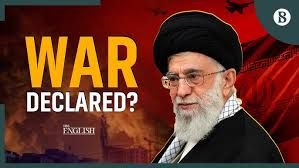
Between December 27 and December 29, 2025, Iranian President Masoud Pezeshkian issued what many analysts are calling the most explicit pre-war signal Tehran has delivered in decades. This was not a slogan. It was not rhetoric for domestic consumption. It was a carefully timed message aimed at two people — Donald Trump and Benjamin Netanyahu — sitting together in a private room in Mar-a-Lago.
Iran did not declare war in the traditional sense.
But it did something arguably more dangerous.
It declared intent.
A ‘New Year’ Message That Sounded Like a War Doctrine
Pezeshkian’s remarks came packaged as a “New Year security outlook.” But the language was unmistakable. Iran, he said, is entering “a total, multifaceted conflict” against the United States, Israel, and Europe — not as a reaction to the past, but as a forward-looking doctrine for 2026.
This distinction matters.
Iran was not responding to the June 2025 war. It was preparing for the next one.
Officials close to Tehran’s National Security Council later clarified that the warning was pre-emptive, designed to shape decision-making in Washington and Tel Aviv before any strikes in the new year.
In short, Iran wasn’t threatening retaliation.
It was warning against initiation.
Why the Timing Matters: The Mar-a-Lago Factor
At the exact moment Pezeshkian’s words hit global media, Israeli Prime Minister Benjamin Netanyahu was in Florida, meeting President-elect Donald Trump at Mar-a-Lago.
The visit was not ceremonial.
According to multiple diplomatic sources, Netanyahu was briefing Trump on what Israeli planners internally call “Phase Two” — a follow-up campaign intended to eliminate Iran’s rebuilding missile infrastructure after the June 2025 ceasefire.
That 48-hour overlap is critical.
Iran’s warning was not broadcast to the world at random.
It was aimed at that room.
The message was simple and blunt:
If you strike our rebuilt missile sites in 2026, the ceasefire is over.
The War Everyone Forgot: June 2025’s 12-Day Conflict
You cannot understand why Iran declares war 2026 is trending unless you revisit what happened just six months earlier.
In June 2025, the region witnessed what is now quietly referred to as the “12-Day War.”
It was short.
It was devastating.
And it changed everything.
Operation Midnight Hammer
- The United States deployed B-2 stealth bombers
- Targets included Fordow and Natanz
- The strikes aimed to cripple Iran’s underground nuclear and missile facilities
The Cost
- 1,100 Iranians killed, including senior scientists and IRGC engineers
- 28 Israelis killed in retaliatory missile and drone strikes
- Massive infrastructure damage on both sides
A ceasefire followed — but it was never a peace agreement. It was a pause.
What Changed Since June? Everything
From July through December 2025, Iran did not rebuild quietly. It rebuilt aggressively.
Western intelligence now estimates that Iran has recovered to near pre-war ballistic missile capacity, aided by external supply chains and accelerated domestic production.
The six-month window after the ceasefire was not recovery time.
It was re-armament time.
That is why 2026 is different.
Why 2026 Is More Dangerous Than Any Year Since the 1980s
President Pezeshkian made one thing clear:
2026 will not look like Iran-Iraq. It will not look like Syria. It will not look like June 2025.
He described a “360-degree siege” — economic, cyber, military, and political.
Pillar One: Economic Snapback
All UN sanctions are now fully reactivated. Iran’s economy is operating in survival mode.
- Currency value collapsed in December
- Inflation crossed critical thresholds
- Protests erupted in Tehran on December 29
History shows that regimes under economic siege often look outward to consolidate power.
Pillar Two: Missile Proliferation
New intelligence reports suggest Iran may now be producing 3,000+ missiles annually, including advanced systems with hypersonic capability.
There is also growing evidence of eastern logistical support, though officials remain cautious about attribution.
The implication is clear: Iran is preparing not for deterrence, but saturation capability.
Pillar Three: The Legitimacy Crisis
The most under-reported factor is domestic.
December’s protests were not ideological. They were economic.
When legitimacy weakens at home, external confrontation becomes a unifying tool. Pezeshkian’s rhetoric reflects that reality.
Status Table: Then vs. Now
| Conflict Era | Primary Tools | Battlefield |
|---|---|---|
| 1980s War | Trenches, artillery, manpower | Borders |
| 2026 War (Potential) | Cyber attacks, sanctions, hypersonic missiles | Everywhere |
This is not a war of soldiers.
It is a war of systems.
So… Did Iran Actually Declare War?
The short answer: No.
The real answer: Not yet — and that’s the point.
Iran has positioned itself so that any 2026 strike can be framed as defensive, not escalatory.
The June 2025 ceasefire was never a resolution. It was an intermission.
The Countdown to 2026: What to Watch Next
All eyes now turn to one event:
The Mar-a-Lago Joint Statement (Dec 30–31)
If Trump publicly mentions:
- “Red lines”
- “Preventive action”
- “Iranian rebuilding”
Expect global searches for Iran war to double within hours.
Markets will react.
Oil will move.
Alliances will shift.
Final Verdict: Shadow War or Main Event?
There is no war today.
But the probability of a January or early-2026 escalation is higher than at any point in the last 40 years.
The ceasefire of June 2025 was not peace.
It was preparation.
2026 may be the year the shadow war steps fully into the light.